

Spotlight: Dave Mason (CT ‘25)
July 15, 2026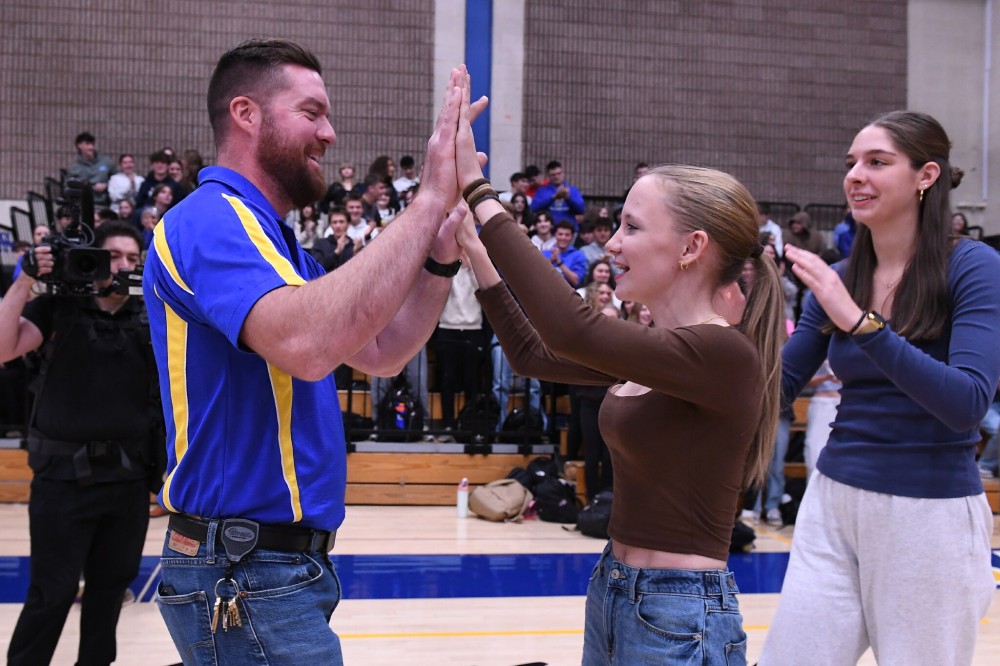
Dave Mason (CT ’25) has transformed Bacon Academy’s Manufacturing program into the largest elective in eastern Connecticut, with more than 130 students enrolled—including a third of them female. Benefiting from state-of-the-art equipment, students learn welding, machining, plasma cutting, metal fabrication and CNC operation, all while gaining the opportunity to receive college credit, earn pre-apprenticeship hours, and build industry relationships. Mason received his Miken Educator Award on October 29, 2025.
Milken Family Foundation: How did you feel during your Milken Educator Award surprise?
I was under the impression we had a schoolwide assembly to celebrate all the wonderful things that our school has accomplished, in particular college-and-career readiness. When I walked in and saw all the central office staff, our industry partners and members of the Connecticut Department of Education, I thought Bacon must really stand out to get all that publicity and celebration. When Jane Foley came out, I recognized her because my colleague, Peter Arseneault, was a Milken Award winner in 2015. Pete is our department head and I thought Jane was there to recognize him as being a major contributor to our school’s success. As she continued to speak, I knew it was for something else and began wondering which one of my colleagues was about to get the surprise of a lifetime. I had a few people in mind that I thought would for sure get their name called, but I never in a million years would have expected to hear mine. When my name was called, I was in disbelief and the moment was surreal. Trying to take everything in at that moment was difficult, but I remember the roar of the gymnasium, the smiles on my students’ faces and the overwhelming excitement in the school that day. I had a quiet minute later that afternoon sitting at my desk asking myself, “Did that really just happen?” It was a day I will never forget.
MFF: It is evident that your students see you as a role model. How do you think your teaching approach inspires students?
My approach to teaching revolves around getting to know my students first, taking a genuine interest in their lives, and establishing a positive rapport. This includes getting to know their families, knowing what teams/clubs they are involved in, and learning about their interests outside of school. Knowing them as individuals aids in content delivery because I can make it relevant to their lives. I always want my students to feel that I am approachable, they can easily connect with me and communicate any issues they might be having inside or outside the classroom. I hope they know that I have their best interest in mind, and I want to help them find their successful path after they graduate.
MFF: How did students respond to your Milken Award?
The weeks following the notification were filled with congratulations of all types. Students who I haven’t had in class would walk by in the hallway or pop their heads in the class to say congratulations. There was a general enthusiasm and excitement around the building. I received countless emails, texts and phone calls from former students and colleagues as well. Former students sent some heartfelt messages explaining an impact I had on them that I was not aware of. It was all a bit overwhelming, but I was deeply touched by all of it.
MFF: What inspired you to become an educator?
My mother is a teacher, and I have looked up to her my entire life. Being a single mother of six kids, she went to work every day and then came home to do everything she could to give my siblings and me a fantastic childhood. She never once complained about any of it because she found so much happiness in doing what she loves. She has always said, “Even on your worst days, the students have a way to bring joy into your life, so it always helps to immerse yourself in that. It will help you get through anything, and you never know the impact you might have on someone’s life.” She just completed her 47th year of teaching and is still going strong. I always admired the enthusiasm she had telling us stories about her days at school. My mother gently steered me in the teaching direction when I was unsure of what I wanted to do after high school. My Technology Education teacher in high school, Keith Doucette, was the one who started to make a career in teaching a reality for me. I took all his classes and excelled in them because of his guidance. If I was going to be a teacher, I wanted to be just like him. Mr. Doucette was funny, compassionate, knowledgeable, and took a genuine interest in the success of his students. During my senior year in high school, I started pursuing schools with a strong Technology Education program, and I ended up at Ohio Northern University.
MFF: At Bacon Academy, how have you built the Manufacturing program into the region’s largest elective while maintaining high certification pass rates and strong industry partnerships?
Building the Manufacturing program to what it is now certainly took several years and constant reflection on ways to improve it. I was not looking to reinvent the wheel since my predecessor had a great program established, but it needed to be modernized and built up. I am fortunate to have had the opportunity to learn from exemplary colleagues who helped me improve my own teaching practices and generate new ideas of how to move the program forward. We started purchasing new equipment for the lab, I implemented new projects that were geared towards current industry skills, gave students the opportunity to create their own projects, and partnered with a local community college to make one of the courses a dual-enrollment opportunity. We also partnered with the Connecticut Department of Labor and the Eastern Workforce Investment Board (EWIB) in 2018 to allow students to earn 150 pre-apprenticeship hours, summer internship opportunities, and networking with local manufacturing employers. Students can also elect to take part in the Youth Manufacturing Pipeline Initiative (YMPI) program. This program focuses on preparing students for the workforce and giving them an opportunity to start a career in manufacturing right after high school. Each year we continue moving the program forward focusing on the needs of the industry and preparing students to enter the workforce with a strong foundational skill set that will allow them to be successful in any career path they choose.
MFF: How have you ensured graduates are truly workforce-ready?
After students pass Manufacturing II, they earn 150 pre-apprenticeship hours that have been certified by the Connecticut Department of Labor. These hours certify that the curriculum they completed in my class is comparable training that employers give their employees who are entering the trades. We have year-round communication with employers and our partners at EWIB to ensure our graduates are prepared to meet the demands of the industry. At the end of their junior or senior year, students who elected to take part in the YMPI program travel to a local college and take the final assessment of the program. This is a hands-on assessment developed by the college and industry partners that evaluates students on their manufacturing skills and knowledge. Once they pass the assessment, they receive a certificate from EWIB that certifies their readiness to enter the workforce. If they do not pass the first time, there are remediation opportunities over the summer to refine skills or concepts they need improvement on and ready themselves for employment.
MFF: How do you define “success” for yourself, and for your students?
Success for me is getting my students into a school or career path they are excited about. Whether it is a four-year school, community college, trade school, on-the-job training, starting a career out of high school, or a mixture of all, I just want to see my students develop into productive citizens and not shy away from their potential. For my students, I define their success to be happy with what they are doing. I want them to find a path that brings them excitement and have the enthusiasm to take advantage of the opportunities that come their way. If I can help them find that path, I believe we both succeed.
MFF: Who are your role models as an educator?
I have had several role models in education and they arose in different chapters of my life. Growing up, it was my mother who first got me interested in teaching. In high school, my teacher Keith Doucette was the one who inspired me to become a Technology Education teacher. In college, my professor Dr. Richard Miller helped me grow and become more confident. He saw the potential in me that I did not see in myself. I did drop out of teaching my sophomore year, but he convinced me to stick with it and believed I would excel in that career. Four years into the profession, I started teaching at Bacon Academy and met Joe Hage. Joe was a veteran teacher and unlike anyone you will ever meet—truly a one-of-a-kind teacher and human being. Joe was a science teacher whose exceptional reputation and eccentric personality preceded him before he entered a room. He unknowingly brought out the best in me as a teacher, and I always loved how he described the profession to me one day. He said, “Teaching is an art. If it was a science, then anyone could do it.” Ironic, coming from the science teacher, but it exemplified his career and approach to teaching. I watched how he built strong relationships with his students and colleagues, always being able to adapt to any situation, making his classroom a center of laughter and excitement while still being able to pull the best out of his students. I have modeled a great deal of my career on the advice I received from him over the years. I am forever grateful to all my role models I have had in my life; they have all shaped me into who I am today.
MFF: What do you hope students remember from their time with you?
I hope my students will remember my classes as engaging, and I hope they enjoyed the time we spent together, and got something out of it, even if it was general life skills or advice. I hope they always know I care about them long after they graduate, and I always want to know the paths their lives have taken them. I love hearing from former students and learning about their careers, families, and even their children I might have in my future classes. Lastly, I always want them to know how grateful I am for them and how they have helped me succeed and revel in this profession.
MFF: Are you working on any interesting initiatives or new projects these days? Is there anything else you want to share about your school?
I am trying to continually improve the Manufacturing program by acquiring new equipment and perhaps adding new internship and co-op opportunities for the students. Things are still in the works. Bacon Academy is a public high school with five different programs within the Technology Education department—Automotive, Manufacturing, Engineering, Construction and Graphic Design. We also have a thriving Family and Consumer Sciences program which offers many classes in Culinary and Early/Middle Childhood Education. Our Business program offers marketing, finance, and accounting classes. Tech. Ed, FCS and Business make up our Career and Technical Education Departments in the building. All CTE programs are highly enrolled, offer dual-enrollment opportunities for students, provide several career paths for students to pursue, and most importantly, are led by a Milken Educator, Pete Arseneault.
Don’t miss any new articles and updates from Milken Educator Awards: