

Spotlight: Kyle Spaltholz (RI ‘25)
April 22, 2026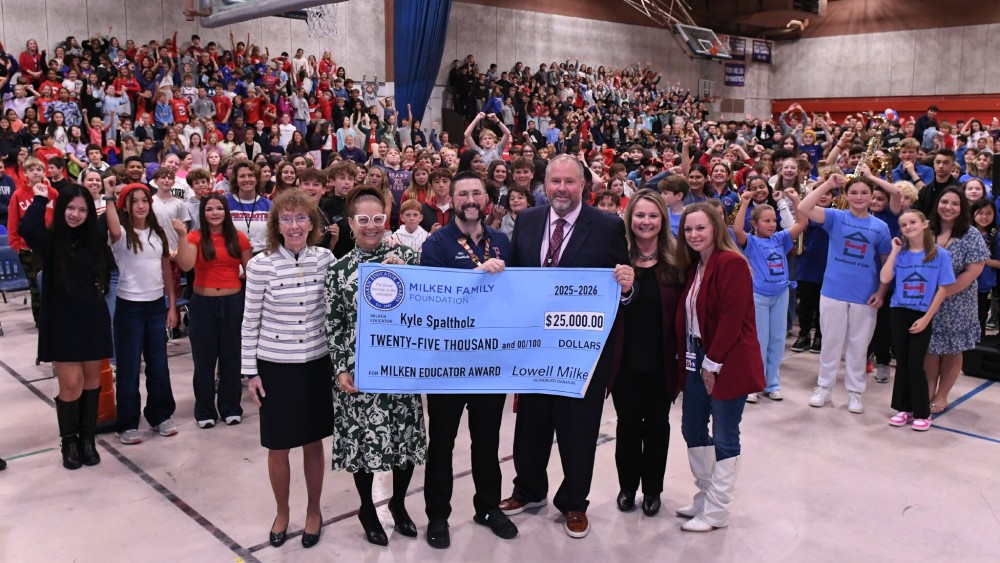
Rhode Island Milken Educator Kyle Spaltholz (RI ‘25) is set apart by his ability to blend data-driven practices with compassion, ensuring every student feels seen, supported, and empowered. From integrating technology and leading district-wide initiatives to creating clubs that build belonging and resilience, his impact extends far beyond his school counseling office. Always innovating and connecting, Spaltholz personifies what it means to prioritize student well-being. Spaltholz received a Milken Educator Award on October 30, 2025.
Milken Family Foundation: How did you feel at your Milken Educator Award notification?
I was completely caught off-guard and couldn’t believe it! I was looking around the gymnasium, wondering which teacher was going to get the Award. In my time at Portsmouth Middle School, I’ve worked with every teacher in the building in some capacity and was thinking about all the wonderful things I’ve seen them accomplish. I was not expecting to hear my own name. It was such a surprise.
MFF: How has receiving the Milken Award impacted your life?
Receiving the Milken Award has given me the opportunity to connect with other professionals outside of my own district. I’ve been contacted by many different people and have already been invited to speak at the first Teaching Forward Conference at the University of Rhode Island with other Milken Educators.
I have also found more confidence in my work. Being recognized with this Award inspires me to continue developing my educational leadership, whether working directly with my students or creating professional development opportunities across my district. I’m always reflecting on my practice, looking ahead to the next day, and deciding what the next right step is for our students. This Award has helped give me the confidence to continue taking those steps.
MFF: What made you pivot from teaching ELA to becoming a school counselor?
I always loved teaching ELA at the middle school level because it gave me the opportunity to teach through one of the most fundamental ways we understand the world: storytelling. Through literature, I could help students develop literacy skills while learning to see the world through the eyes of others.
Later, I was given the opportunity to become an instructional systems coach, which allowed me to bring my classroom experience and knowledge of educational technology, MTSS, and other school systems to my school and the district through professional development. While I loved this opportunity, I didn’t lose sight of why I became an educator: the students.
During one of my years as an ISC, I was called to the counselor’s office to meet with a former student. They shared that they had been going through a difficult time, but something I had said in class stayed with them and led them to seek help. As I supported the student and worked with the counselor to coordinate care, I gained a deeper understanding of the impact of social-emotional learning.
After that experience, I wanted to create change not only for that student, but also for all students—academically, behaviorally, and in planning their futures. I am so grateful to be in this role, where I can support students and help our schools develop a Recognized ASCA Model Program (RAMP) to ensure all students have access to the support they need to succeed.
MFF: How has your experience seeing the synergy between data-driven school counseling and classroom teaching shaped your solution-oriented, student-first approach?
My experience in school counseling and classroom teaching has shown me that being data-driven allows for a proactive, responsive approach rather than a reactive one. While there are times when we need to be reactive, I’ve found that using data helps me focus my time and interventions where they will have the greatest impact.
Data also supports a collaborative, team-based approach with teachers, interventionists, and other staff to prioritize a whole-student focus using evidence-based practices. At the same time, building strong relationships and trust is essential so students feel cared for and supported. When students feel seen, supported, and valued, they are more responsive to interventions.
Balancing data with relationships has shaped my whole-student approach, ensuring that the individual needs of every student are met.
MFF: How do you define “success” for yourself and your students?
My definition of success is grounded in the idea of “always doing your best,” a concept from The Four Agreements. I remind my students that their best will vary from day to day, and that showing up with effort and self-awareness is what truly defines success.
There are many things in life we cannot control, from unexpected challenges to plans not going as hoped. What we can control is how we show up each day. Some days we feel ready; other days we may be struggling or not feeling well. If we can give ourselves grace and know we did our best, nothing can take that away. This mindset helps build resilience, which is essential for growth in today’s world.
MFF: How have you focused on building emotional resilience in students?
I work with students to build emotional resilience in several ways. Middle school is a time when students are seeking independence, but they also begin to realize that some things are within their control and others are not. That’s a lesson we all need at times.
Helping students identify what they can and cannot control becomes a powerful tool as they grow more independent through adolescence and into young adulthood. A growth mindset is also key. Working with teachers to model this mindset in the classroom has been impactful. Normalizing that struggle is part of learning and helps students continue to build resilience throughout middle school and beyond.
MFF: Who are your role models in counseling and education?
My two role models are Lori Lebrun and Onna Holland, both of whom I had the privilege of meeting during my graduate studies at Providence College.
Lori Lebrun was my professor for my practicum and internship courses. She was named Rhode Island School Counselor of the Year in 2012 and showed me what it means to be a compassionate, student-centered advocate. She taught me that if a problem feels big to a student, then it is big—and they deserve to feel seen and heard. She also supported me in bringing Anchored4Life to my school as part of my internship legacy project.
Onna Holland is an educational specialist in school counseling for RIDE [Rhode Island Department of Education] and has influenced my thinking around school-based systems. Her leadership in advancing comprehensive, data-driven counseling programs aligned with the ASCA National Model inspires me to continue growing our program. She continues to guide me today as I deepen my understanding of students’ evolving needs and the importance of a whole-student approach.
MFF: What is your wish for your students?
I wish for my students to be their own biggest cheerleaders. We spend our entire lives with ourselves, so it’s important to treat ourselves with kindness and respect. When students learn to support themselves, they build the confidence and resilience needed to face whatever challenges come their way.
MFF: Is there anything you are working on or things going on at your school?
As I continue working toward earning a Recognized ASCA Model Program (RAMP) designation for our school, much of that work is supported by Portsmouth Middle School’s PBIS framework. We use “Patriot Pride” to reinforce our core values: being safe, respectful, responsible, and ready to learn.
Over the past few years, we’ve implemented consistent schoolwide expectations that are taught and reinforced by all staff through advisory lessons and daily practices. This work has led to recognition at the Northeast PBIS Conference with a Bronze Level Award. Schoolwide systems such as daily and monthly recognitions, along with spirit days, reinforce positive behaviors and expectations.
We have also developed a system to improve student attendance through proactive family communication and targeted Tier 2 supports, including goal-setting and regular check-ins. These efforts have resulted in measurable success.
Additionally, we use our advisory block for Tier 1 lessons to support students’ social-emotional learning. Portsmouth Middle School continues to refine a whole-student approach that supports academic and social growth. I am proud of the work we’ve done and continue to do each day for our students.
Don’t miss any new articles and updates from Milken Educator Awards: